Signed in as:
filler@godaddy.com
When you adopt one of CRC’s crocodile ambassadors, you’re helping provide the care they need to live a healthy, enriched life in captivity. Your support helps ensure access to nutritious food, veterinary care, enclosure maintenance, enrichment, and the daily care and attention these remarkable animals deserve throughout their lives.
But adopting a croc means more than supporting one incredible animal. Your contribution also helps CRC continue its mission of providing lifelong care to wildlife that cannot return to the wild, while educating communities and visitors about crocodiles and their vital role in healthy ecosystems. By becoming an Adopt-a-Croc supporter, you’re helping us care for these ambassadors while giving them a second chance to inspire people to better understand, respect, and conserve crocodiles in the wild.
Be part of the CRC family and mission- adopt a croc today!


$100BZ/$50US
You will receive a picture and update of the adopted croc or animal currently under rehabilitation care.
Please select the "Monthly" option on the PayPal donation page if you would like to make recurring monthly donations.
$1,600BZ/$800US
You will receive a personal monthly video of your adopted croc or animal currently under rehabilitation, in addition to a written update and picture.
Please select the "Yearly" option on the PayPal donation page if you would like to make recurring annual donations.
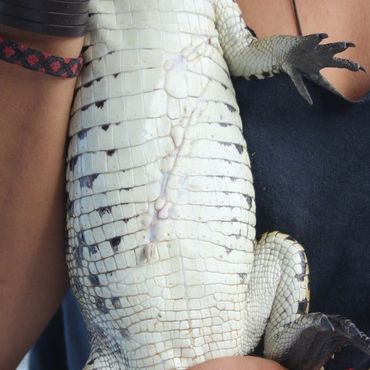

Maester Aemon (for you Game of Thrones fans, you’ll know why we named him Aemon!), came under CRC's rehab after being rescued from Corozal District in November 2018. He was found emaciated and had severe damage to his eyes from a hard blow/machete chop to the head. Given his behavior and reaction during target training sessions, Aemon is
Maester Aemon (for you Game of Thrones fans, you’ll know why we named him Aemon!), came under CRC's rehab after being rescued from Corozal District in November 2018. He was found emaciated and had severe damage to his eyes from a hard blow/machete chop to the head. Given his behavior and reaction during target training sessions, Aemon is completely blind in his right eye and has poor eyesight in his left eye (possibly distinguishing between light and darkness). This trauma likely led to Aemon's emaciation as crocs use part of their vision for successful hunting despite other sensory organs that allow them to hunt.
Aemon has proven to be the smartest and most chill of the crocodile ambassadors (truly living up to his name as Maester Aemon!). He picks up training cues quickly, and loves giving us a “smile” so we can inspect his teeth as well as the inside of his mouth to look for any signs of bacterial or viral infections. But he’s also the most dramatic – after training he loves to give a good jump and splash into the water!
November 2019, the CRC became the caretaker of Gilly, a male Morelet’s crocodile who had spent more than three decades under the care of renowned nature filmmakers Richard and Carol Foster. Gilly first arrived at their Savannah Guest House as a young juvenile in the early 1980s and became a beloved part of their lives.
Following Richard’s
November 2019, the CRC became the caretaker of Gilly, a male Morelet’s crocodile who had spent more than three decades under the care of renowned nature filmmakers Richard and Carol Foster. Gilly first arrived at their Savannah Guest House as a young juvenile in the early 1980s and became a beloved part of their lives.
Following Richard’s passing in 2018, Carol made the difficult decision to find Gilly a new home where he could continue to receive the care and attention he deserved. On the recommendation of Sharon Matola, founder of The Belize Zoo, Gilly came to the CRC—where we were honored to continue the legacy of care that Richard had provided for so many years.
Today, Gilly is one of the CRC’s most recognizable ambassadors, helping us challenge misconceptions and share the intelligence, individuality, and importance of crocodiles. He is considered one of the largest Morelet’s crocodiles in captivity and has even shared the screen with Steve Irwin, who filmed with Gilly in Belize in 2003.
From a young crocodile in the Foster family’s care to an ambassador for crocodile conservation, Gilly’s story represents the lasting connection between people, wildlife, and the responsibility we have to protect both.
In early April 2022, CRC began receiving messages from various residents of Hopkins about a croc coming up on the beach. Originally we figured it was a female croc trying to find a place to nest. However, videos and close-up photos illustrated an emaciated crocodile that likely was trying to find a place to rest.
Finally, Hamanasai Resor
In early April 2022, CRC began receiving messages from various residents of Hopkins about a croc coming up on the beach. Originally we figured it was a female croc trying to find a place to nest. However, videos and close-up photos illustrated an emaciated crocodile that likely was trying to find a place to rest.
Finally, Hamanasai Resort in Hopkins gave us a call as staff were concerned of a sick croc that was on the beach in front of the resort. CRC responded promptly, and upon arrival thought the croc was dead given it barely moved. It was clear this croc was dehydrated and lethargic, and upon capture we observed wounds on its skull and abdomen that illustrated this 8ft croc was in a bad battle with a larger crocodile. The trauma from the fight likely led to the croc becoming blind (he has NO eyes), making the croc incapable of successfully hunting leading to its emaciation.
Crocs can suffer and fight bacterial and viral infections for a long time. Several months after being under CRC care and gaining weight, we began observing Hamanasi was struggling opening his mouth. An infection around his mandible was causing a lack of opening; and this infection seemed to spread to his ear canal as now it does seem he has limited hearing capability. Now Hamanasi mainly relies on his ISOs for training given his hearing seems a bit impaired.
Hamanasai, named in honor of the Hamanasai staff of wildlife champions, is a male American-Morelet’s croc hybrid who has adapted to his new home at the CRC facility. Although blind, Hamanasai is doing well with basic target training cues.

Savannah, a female Morelet's crocodile, was seized by the Belize Forest Department in June of 2023.
She was illegally held as a pet for five years in Spanish Lookout, being fed solely chicken and kept in a small algae-filled pond. After a vet check-up by Belize Wildlife and Referral Clinic, she was brought to the CRC for long-term care.
Savannah, a female Morelet's crocodile, was seized by the Belize Forest Department in June of 2023.
She was illegally held as a pet for five years in Spanish Lookout, being fed solely chicken and kept in a small algae-filled pond. After a vet check-up by Belize Wildlife and Referral Clinic, she was brought to the CRC for long-term care. She is unable to be released back into the wild due to over-habituation, and lack of teeth due to poor nutrition.
Her name was given to her by a local kid from St. John's Primary school in Placencia who won our 'Name that Croc' contest.
Previous owners mentioned they took Savannah out of the wild when she was a hatchling, and they mentioned it was 5yrs prior to relinquishing to Forest Department.
.jpeg/:/rs=w:365,cg:true,m)
Auggie was rescued from a traumatic situation that left him blind. One of his eyes was poked out, the other damaged from a hard blunt force to the eye that he can barely see out of it. He was kept on a block of ice in a cooler, only taken out to be handled by tourists for photos. Luckily a local Wildlife Champion contacted Belize Forest D
Auggie was rescued from a traumatic situation that left him blind. One of his eyes was poked out, the other damaged from a hard blunt force to the eye that he can barely see out of it. He was kept on a block of ice in a cooler, only taken out to be handled by tourists for photos. Luckily a local Wildlife Champion contacted Belize Forest Department, and Auggie was rescued and immediately sent to Belize Wildlife and Referral Clinic for veterinary care. At just 2ft, it was unsure if this juvenile Morelet’s crocodile would survive given the conditions he had been under had caused some internal injuries as well.
In November 2023, Auggie was transferred to CRC where his behavior indicated his eyesight was too poor to be released. He is now one of our most important ambassadors in educating people about the dark side of illegal wildlife tourism, and that all wildlife deserves our empathy and protection.
Interesting enough, when Auggie first came to us he didn’t show himself for about 8-9 months. We then had Next Gen Croc students start hanging out and talking with Auggie, and within 2 weeks he came out and we began the training process!
Starting in May 2025, a crocodile in the Maya Beach neighborhood on Placencia Peninsula were starting to take dogs. Originally we thought this was due to indirect feeding given the amount of workers in the area throwing food scraps into the lagoon and canals (and one dog was attacked by a small croc due to indirect feeding). Early Decembe
Starting in May 2025, a crocodile in the Maya Beach neighborhood on Placencia Peninsula were starting to take dogs. Originally we thought this was due to indirect feeding given the amount of workers in the area throwing food scraps into the lagoon and canals (and one dog was attacked by a small croc due to indirect feeding). Early December around 11pm at night, a community member alerted us of a croc trying to get into someone's yard where the dog was barking. Thanks to various community members we were able to catch Einstein, and it was the following morning we realized his eyes were fogging, as if he had cataracts or glaucoma in both eyes. Thus due to poor eyesight, he was going after easy prey- people's pets.
Einstein was caught by the CRC in 2020 when he made home to a 1 acre pool on someone's farm. For 3 weeks he outsmarted every known crocodile and alligator trap in the world, not setting off the traps but being able to get the week. Given him outsmarting us in every way, he was appropriately named Einstein. At this time, his eyesight was perfect. So, what could have caused the poor eyesight? It's uncertain but vets have proposed a long exposure to poor water quality. Given Einstein's poor eyesight, he is now one of our croc ambassadors at the CRC where he can educate people about his species, the American crocodile, and the importance of keeping our ecosystems healthy.